Thursday, January 2, 2014

Major Passenger Train Wreck, Montgomery, IL, September 27, 1964

Introduction to the Wreck


This wreck involved trains of the Chicago, Rock Island & Pacific RR and the Chicago, Burlington and Quincy RR.  It happened on the CB&Q at their Montgomery Tower in Montgomery, IL.  Montgomery Tower was the first interlocking plant west of Aurora, IL on the CB&Q double-track mainline to Galesburg, IL.  The  CB&Q's single-track Streater Branch headed off to the southwest and crossed the CRI&P at Ottawa, IL about 40 miles down the branch.  The pictures in this blog were taken the morning after the wreck, September 28, 1964.   The Rock Island was repairing its Des Plaines River Bridge in Joliet on its mainline and was detouring trains to Chicago up the CB&Q branch and trains to the west down it.

An interlocking plant is a location where trains may switch tracks, enter a train yard, or diverge to a different line as at Montgomery.  Montgomery was operated by a CB&Q employees called a levermen.  An interlocking plant is a large mechanical device that will not allow the tracks to be routed so a collision between trains occurs.  But it did at Montgomery.  Before the investigation, everybody who understood the interlocking concept said the wreck was impossible.


As the diagram shows three trains, all passenger, were at Montgomery at the time of the wreck.  An eastbound Rock Island waiting at a home signal (a signal on the signal bridge to allow a train to enter the interlocking plant) to come off the branch (upper right on the diagram).  It was CRI&P Extra 656 the combined Golden State and the Rocky Mountain Rocket.  The second was a Rock Island westbound on Track 1, the normally westbound track (both tracks were signaled in both directions), waiting at a home signal to go down the branch (lower left on the diagram).  The third was CB&Q #3, the combined Ak-Sar-Ben Zephyr and American Royal Zephyr, westbound at 59 mph on the normally eastbound track.  Due to an error in upgrading the plant to electric-powered turnouts compromised the integrity of the plant and turnout #14 was improperly set for the branch and the Zephyr veered off into the waiting Rock Island train. Indications were that the operator had no indication of this error.   Track turnout #14 was set for the branch and the Zephyr veered off into the waiting Rock Island train. The wreck took place at 10:49 p.m. on the 27th.   

The known diesel numbers are shown on the chalk diagram drawing I drew right after the wreck.  Some computer additions have been made to the diagram.  On the diagram the interlocking plant is between signal bridges drawn like an uppercase letter I across the tracks.  The home signals are on those bridges.  The importance of the track that curves behind the tower labeled “to SHEEPYARDS” will become apparent.

Three CB&Q employees (two in the lead CB&Q engine) and one in the RI lead engine were killed. 200 hundred passengers and other employees claimed injuries but amazingly only five remained in a hospital more than one day. ) I was the night operator leverman at the tower two weeks previously. The operator that night collapsed of a nervous breakdown soon after the wreck. Some of the details in this album are from the October 1965 TRAINS Magazine article titled The Accident That Couldn't Happen by Mike Woodruff. The article goes into some detail on how interlocking plants work and what went wrong that horrid night. 
 
The extremely interesting Interstate Commerce Report on the accident is here: https://www.jonroma.net/media/rail/accident/usa/icc/Ex%20parte%20244.%20CB%26Q.%20Montgomery%2C%20IL.%201964-09-27.pdf?fbclid=IwAR0HAVsmZx_dDzHUSNEEfa5hLTxLePRDJ5U_JfQf5fZc5Zxyfatc3GaVp2U


This diagram shows the situation as I found it on the morning of the 28th.   The second CRI&P train had been removed (towed back to at least Aurora) and the first CB&Q diesel though shown was mostly gone. Two steam wrecking cranes with their trains are present.  The 27 pictures in this blog are numbered and the number and direction of each picture is shown on this diagram.  The Ak-Sar-Ben Zephyr had three units, four stored mail cars (J), two baggage cars (B), three coaches (C) two Pullmans (S), and a heavyweight diner (D).  The headend cars (mail and baggage) accordioned, no doubt absorbing much of the impact and protecting the passenger cars somewhat.  The lead CB&Q diesel jackknifed and the first Rock Island diesel took to the air.

Pictures of the Wreck


Picture 01:  The steam crane to the east of the wreck rerailing the last Ak-Sar-Ben Zephyr car, a coach.  This first one is easy.
Picture 02:  CB&Q Heavyweight Diner and Pullman "Silver Craig" originally purchased for the California Zephyr as it says on the Letter Board.
Picture 03:  Mustard and Ketchup On Your Hot Dog?  The car to the left is Denver Rio Grange &  Western Diner "Silver Gorge" the other is CB&Q Pullman "Silver Crag". Both are California Zephyr cars.
Picture 04: Zepher Cars
Picture 05: The accordianed Zephyr headend cars.

Picture 06: Seven of the nine diesel units involved.

Picture 07:  This unit was repaired and became Burlington Northern 9987 and pulled/pushed commuter trains in and out of Chicago.


Picture 08:  E7A 9922B was subsequently scrapped. She was 19 and obviously not worth the repair expense. E9A 9987A at the right however was returned to service.
Picture 09
Picture 10:  I can find no information if Rock Island 651 was rebuilt.
Picture 11:  This diesel was later used in suburban service.
Picture 12:  Too closely spaced.
Picture 13 : Rail laying over.
Picture 14:  This looks like the cab to the first Rock Island unit.
Picture 15:  The first train through using the "Sheep Yards" track down and through the yard and back up to the Aurora Depot.
Picture 16
Picture 17:  First train through using the sheep yard lead track. Pieces on the ground are parts of the lead Zephyr diesel unit.
Picture 18:  One of the first trains through using the Sheep Yard lead track. Parts on the ground are from the lead Zephyr diesel.
Picture 19:  Cab of Zephyr lead diesel.
Picture 20: Zephyr headend cars.
Picture 21:  First train through on Sheep Yard lead track and Zephyr baggage car.
Picture 22:  Last CB&Q baggage car and first two coaches.
Picture 23:  Second CB&Q coach and two Pullmans.
Picture 24:  Looking west from Montgomery Tower (screen on window). One crane and its cars are to the left. Sheep Yard lead track is center with rods from tower to its left.
Picture 25:  Looking west from tower (screen on window). One crane and its cars are to the left. One of the first trains is on the Sheep Yard lead track.
Picture 26: First train through on Sheep Yard lead track behind the tower.

Picture 27: First train through on Sheep Yard lead track behind the tower.

In Closing ...


Unlucky 656.  This was the third wreck for Rock Island diesel unit 656.  It was rebuilt and upgraded the first two times, but not this time.  What engineer would want to run her?

CB&Q Montgomery Tower 15 days before the wreck. These were called strong-arm plants and sometimes you had to use a leg too as demonstrated in this self portrait.  If school had not begun, I may have been the leverman that awful night!

Montgomery interlocking today.  The tower is long gone and the interlocking is operated by a remote dispatcher.

Friday, October 11, 2013

Downers Grove Depot Front Sheared Off by Goddesses

In 1947 the "Train of the Goddesses" (one of the second pair of Twin Zephyrs) derailed at speed and hit the Downers Grove Main Street Station shearing off the front. Downers Grove is a Chicago suburb 22 miles from the city. Three people were killed and 30 injured in the accident.

Downers Grove Main Street Station, March 29, 1964


This is from the Downers Grove Historical Society.  The men in the foreground are restoring one of the tracks to get the railroad partially operating.


In November 1947 the repaired trainset was reassigned to Nebraska Zephyr service between Chicago and Lincoln, Nebraska along with the "Train of the Gods".

The ICC accident report indicates that the derailment of Train #24 was caused by it hitting a bulldozer which had fallen off a flatcar in a freight train on the middle track. No. 24 was moving at about 73 mph when it hit the bulldozer, the locomotive involved was E5A 9914A "Silver Arrow" which was also repaired and returned to service. The engineer of #24 was one of the fatalities.

9914A, an E5A, built in June 1941 and was traded in March 1968. Most of the cars from the Train of the Goddesses are at the Illinois Railway Museum and run as a train.

Of interest are the names of the cars.  The cars of the "Train of the Goddesses" were named Venus, Vesta, Minerva, Psyche, Ceres, Diana,and Juno. Those of  the "Train of the Gods" were named Apollo, Mars, Neptune, Cupid, Vulcan, Mercury, and Jupiter.

Here's a YouTube video of Illinois Railway Museum's Nebraska Zephyr passing the station on the same track in 2012 by Patrick Kearn.

http://www.youtube.com/watch?v=ZcSRB8oaQKM

And note the following advertizement.


And I found another photo.


Wednesday, July 24, 2013

A Window Into The Real Norfolk Southern


The original Norfolk Southern Railway Co. operated in Virginia and North Carolina between 1891 and 1974 when the Southern Ry bought it but kept the name.  The Southern  merged with the Norfolk & Western to form the current Norfolk Southern Ry.  It's identity is gone but some pieces of the original Norfolk Southern operate as short-line railroads operated udifferent names and separate from the Norfolk Southern.

The map below shows the original Norfolk Southern in its maximum extent prior to 1974.
My window into the Norfolk Southern was 1968, 69, and 70 when I lived in southeastern Virginia.  I knew little about the railroad but it would once in awhile show up as I was scouting for trains in various cities.  Locomotivess 1 through 17 were GP18s.  Number 6 below kindly waited on May 24, 1970 in Plymouth, NC for me to show up and take its picture.


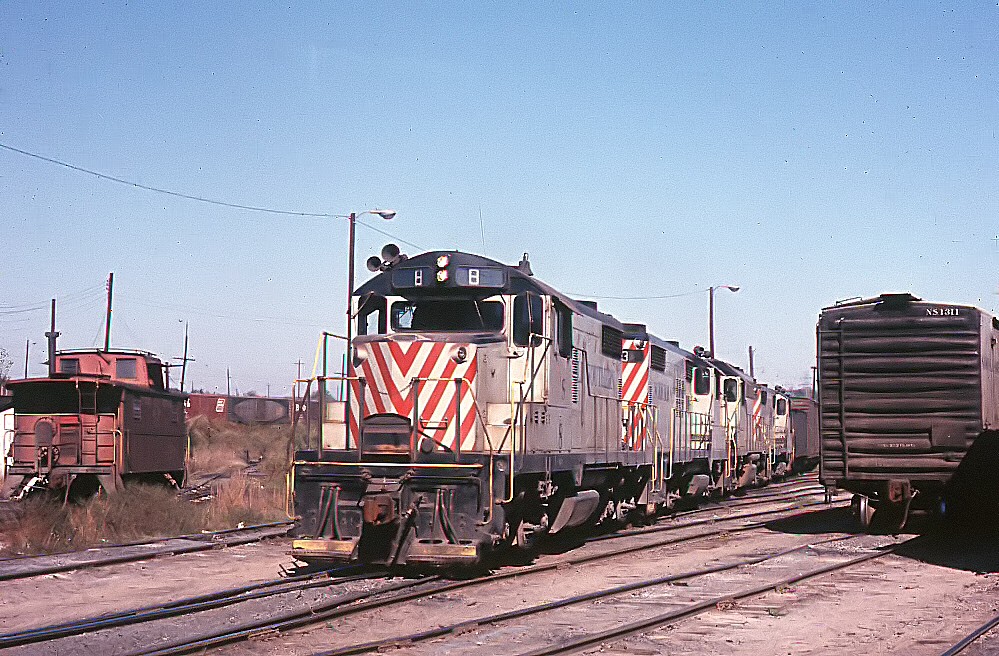
Geeps 8, 3, 2001, and 13 are about to pull in Charlotte, NC on October 27, 1968.  2001 is a GP38.  The following pictures show the other units on the train.  Also note the NS boxcar #1311 to the right in the first shot.


I was surprised to learn that the Southern rebuilt the NS geep with a high short hood and long nose forward.  Was there some sort of union agreement?

Here are two pictures of #11 working in Norfolk in May of 1969.


I volunteered at the North Carolina Transportation Museum last winter and guess what was there?  NS 1616, a non-operable Baldwin AS416.  I had taken NS 1617 in Chesapeake, VA in May of 1969.  And yes I duplicated the picture as nearly as possible.


During the summer of 1963 I worked for the CB&Q filling in for vacationing agents, operators, and levermen.   As the agent at Leland, IL for a couple of weeks, I found NS 28226 on the team track.  I no doubt handled the waybills for the car.  I doubt I knew anything about that NS.  Didn't know I'd be photographing it by the end of the decade and 50 years later photographing its metamorph.


I hope you enjoyed this peek through the window my camera made.

As you might expect the original NS has a historical society.  Their website is here:
http://www.norfolksouthernhs.org/equipment.html

Tuesday, July 23, 2013

EMD E5s and E6s I Have Known

I Have Known

Well "known" is really stretching the term.  I'll show you E5s and E6s where photons from the sun bounced off the locomotive and impinged the Kodachrome in my 35mm camera.  So it wasn't an intimate relationship.

I've photographed Rock Island and Seaboard Coast Line E6s and CB&Q E5s.  The main difference between an E6 and an E5 is the stainless steel body of the E5s.

Where to start.  Well, with the most recent, the years I spent in Ashland, VA (1968 to 1972) during the transition from SCL passenger trains to Amtrak passenger trains.  Then I'll bounce back to my roots in Chicagoland and present the Rock's two contributions.  And then the ones I love.  The ones with names starting with Silver.

But First a Tad of Background

E5s and E6s had two 1000hp model 567 Diesel engines each running a generator to power the traction motors.  16 F5s were built (11 As and 5 Bs) in 1941 and 42. C&S and FW&D each had an A and a B and the CB&Q had the remainder.   91 E6As and 26 E6Bs were built between November 1939 and September 1942 for 14 roads.  ACL had the most, 22As and 5Bs.

Considering that there were a total of 1,251 E7s, E8s, and E9s built.  The probability of finding an E5 or and E6 heading a train was small unless you knew where to look.

Seaboard Coast Line's E6s


This is actually a very special locomotive. She was built as an E3 in November of 1939 but wrecked in the late 1940s and rebuilt to E6 standards.  She still exists, painted in her original Atlantic Coast Line "The Champion" (modern NYC/Miami passenger train) purple motif at the North Carolina Transportation Museum.  In the above picture she is on the ready track at Broad Street Station (Richmond, VA) waiting her next assignment.  It's January 17, 1970.  Below she is be washed by volunteer Noah last spring (2013) for a special event at the Museum.

Actually she was built by EMC (Electro-Motive Corporation) before in became a division of GM, i.e., EMD (Electro-Motive Division).  One could argue she is the last remaining E3.  She ran over 6 million revenue miles before she was retired circa 1970.  Then tourist railroads put more miles on her.


This shot in Richmond clearly shows why they were called shovel nosed.  The F-units and higher numbered E-units had much flatter "bulldog" noses.

Both Seaboard Air Line and Atlantic Coast Line had E6s.  When those lines merger to form the Seaboard Coast Line only the ACL 6s remained.


And a close-up also in Richmond.


Out on the road their 2,000 hp would knock down the miles with ease.  Here E6A 514 is mated with an E7A with Train 85, The Everglades, on September 15, 1969 in Richmond, VA.


Here's 514 again this time with the northbound Glades near Ashland, VA, also in September of 1969.

On this March 1969 day, E6A #518 has charge of Train 22, the Silver Star at Richmond.  Quite a train as the next two pictures show.


518 also on the ready track at Broad Street Station.


Here E5A 519 is north of Ashland, VA the northbound Everglades in September 1968.
 

521 is at the Ivy City Engine Terminal north of Washington Union Terminal waiting the evening southbound parade of trains.


The Rock Island E6s

The CR&P had five EAs.  Only 630 and 631 hung around long enough for my camera to capture their photons.  I photographed 630 in Chicago/Joliet commuter service many times in three different paint schemes but she was never painted during that period in the classic "Rocket" scheme which she now wears.  The last photo I can find of her was taken at Mid-America Car in Kansas City in May 2012.

My two favorite shots of 630 were taken the same morning at Englewood Union Station on Chicago's south side. It was Easter Break 1965 on a beautiful April morning.  The first shot is an inbound commuter and the second an outbound.  WOW, in the second she sure looks good in the morning sun for a 24-year old dame.  She's crossing the Pennsylvania RR diamonds.  Behind her is a transfer of piggy-back cars to the small downtown piggy-back yard the Rock Island had near the Loop.


I caught 630 in another paint scheme in March of 1971 working a commuter train in Joliet, IL.  This surely was a plain Jane scheme.  In the first picture she is at the platform and in the second beginning her pushing toward a green signal and on to LaSalle Street Station.


Six years later 630 was caught delivering an afternoon-commute train to Blue Island.  The paint scheme has been spiffed up with a gold nose and redder flanks, al beit dirty.


I only caught E6A 631 once.  Here she has just started to hustle the Golden State (Tr. #3) toward the Golden State seen passing the 99th Street commuter stop.  The Rock Island will hand the train off to the Southern Pacific at Tucumcari, NM for the remainder of the run to Los Angeles.  631 and the two E7B units behind her will no doubt be turned to that the eastbound back home to Chicago.


 Now the Silver E5s

By far my favorite shot of the CB&Q's E5s is this one of 9912AB shooting the eastbound Morning Zephyr across northern Illinois through the sleepy town of Chadwick just after lunch with a 129 miles to Chicago on August 24, 1964.  Their names:  Silver Meteor and Silver Comet.


I worked for the CB&Q during a couple summers my college years and was the agent at Chadwick that day.  The dispatcher's line gave me the heads-up on what the Zephyr's power would be.  That gave me time to set up this shot.  Below are three more shots of 9912A. The first two are at St. Paul Union Depot on June 27, 1964.  Don't call that  Northern Pacific SW1200 switcher #155 ugly just because it's sitting next to such a beauty.  They both had their job to do.


Here is the 9912A and two E7s at Prescott, WI on June 30 1964 about to cross the St. Croix River into Minnesota.  Because the train is coming off double track for the single track bridge, the passenger cars can not be seen.


I was also fortunate to capture Silver Clipper 9915B several times.


On July 5, 1963 the Silver Clipper lead the Galesburg Local (Train #2) at 9:45 a.m. (9 minutes late) at Sandwich, Illinois -- 56 miles west of Chicago.  Her name had been blanked out and Note 5 in the "Official Guide" says "Checked baggage will not be handled."


And a profile at Sandwich that morning,
 

Wishing for a wider angle lens so I could get closer and get her all in (Minneapolis in June 1964).

Here she and an E7A were taking Train 21, The Morning Zephyr to the Twin Cities through Milledgeville, IL on August 20, 1964.   Note the four domes.

What 5s and 6s Survive?  Only 4 A-units!

  • Atlantic Coast Line 501, built as an E3, rebuilt as a E6 after a wreck, at the North Carolina Transportation Museum
  • Chicago Burlington & Quincy E5A 9911A at the Illinois Railway Museum
  • Louisville and Nashville E6A 770 at the Kentucky Railroad Museum
  • Chicago Rock Island & Pacific E6A 630 hopefully being rebuilt in Kansas City
Note, of the 511 E7s built, we have only saved one.  Many E8s and E9s survive.